A documentary examining large-scale deforestation and Indigenous resistance in Papua has sparked controversy in Indonesia after several public screenings and discussions were reportedly disrupted by authorities.
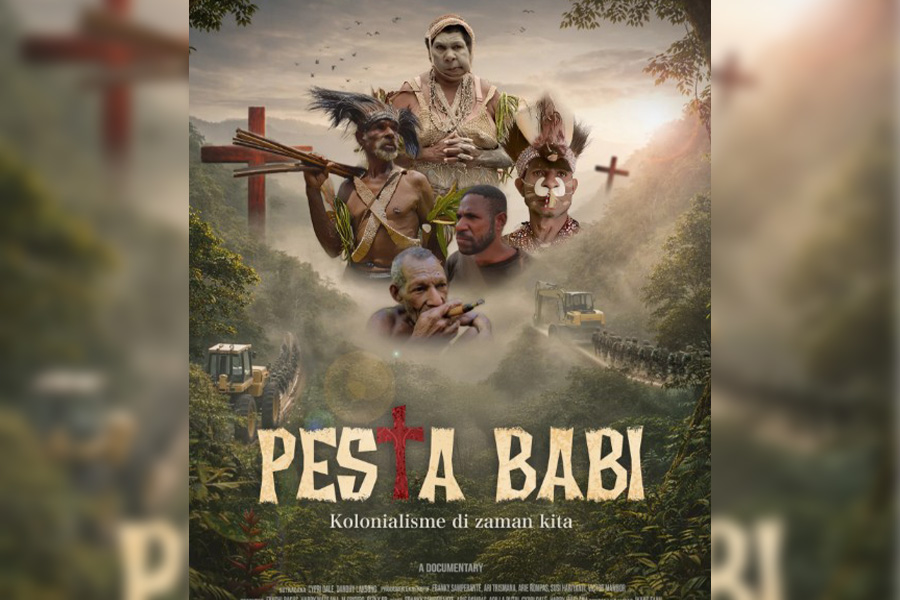
Pig Feast: Colonialism in Our Era (Pesta Babi: Kolonialisme di Zaman Kita), directed by Cypri Paju Dale and Dandhy Laksono, focuses on rapid forest clearing in South Papua linked to agribusiness expansion, including sugarcane plantations for bioethanol production.
The 95-minute documentary centers on Indigenous Papuan communities, including the Marind, Awyu, Yei, and Muyu peoples, whose customary lands in areas near Merauke, Boven Digoel, and Mappi have been affected by plantation expansion and food estate projects.
The film says up to 2.5 million hectares of Papua’s forests could be converted into industrial plantations under projects promoted in the name of “food security” and “energy transition.”
It also documents resistance by local communities who, according to the film, want to preserve their forests, rivers, and traditional food sources rather than surrender ancestral lands to large-scale development projects.
Human rights activist Sandyawan said the documentary connects present-day land conflicts with decades of state presence in Papua.
“This film not only shows images of collapsing forests and the voices of Indigenous people resisting, but also weaves together 60 years of state presence in Papua into a single narrative: that behind the slogans of ‘food security’ and ‘energy transition,’ there is an ongoing practice of territorial control which the filmmakers describe as the new face of colonialism in the modern era,” Sandyawan wrote in a seminary alumni discussion group.
One of the documentary’s central images is the spread of what communities describe as the “Red Cross Movement,” in which Indigenous residents erect giant crosses and traditional barricades to oppose land clearing and corporate expansion. The film says at least 1,800 crosses have been planted across southern Papua.
The title Pig Feast refers to Awon Atatbon, a Muyu customary ritual involving pigs as important social and cultural symbols. According to the film, the ritual depends on the survival of Papua’s forests and natural environment.
Public screenings and discussions of the documentary have reportedly faced disruption in several parts of Indonesia.
At the University of Mataram in West Nusa Tenggara, a screening was reportedly shut down by university authorities last week.
A Jesuit priest also said a planned public screening in Yogyakarta was canceled after pressure from authorities. “Yogyakarta’s student pastoral community went viral after authorities pressured organizers not to screen Pig Feast,” he said.
In North Maluku, a screening and discussion at Fort Oranje organized by the Alliance of Independent Journalists Ternate and the Society of Indonesian Environmental Journalists North Maluku chapter was also reportedly disbanded by local security forces.
According to organizers, security officers visited the venue before the event and documented committee activities. During the screening, authorities allegedly asked organizers to stop the event because the film was considered sensitive and potentially capable of triggering conflict.
Despite the reported disruptions, public interest in the documentary has continued to grow.
“The screen can be turned off, but courage is not easily extinguished. The more it is banned, the more it spreads,” one Indonesian social media user wrote in response to the reported shutdowns.
Another online commentator described the film as a reflection of political power and public accountability.
“Art is a mirror. When that mirror reflects the ugly face of power, the one that becomes angry is not the mirror, but those who fear being seen,” the commentator wrote.
Interfaith activist Indro Suprobo, speaking to AsiaNews, criticized efforts to prohibit screenings and discussions of the documentary.
“The logic behind these acts of prohibition is difficult to understand. The banning of social analysis and critical studies through film by intellectuals and academics appears to confirm Louis Althusser’s argument that educational institutions have the potential to position themselves as ideological state apparatuses operating in favour of those in power,” Suprobo said.